Outlook/Exchange Authentication in Davmail
~10 min
I have previously written an article about
setting up Outlook/Exchange email on Linux, in which I
discussed using davmail(1),
a Java program that allows using a standard IMAP/SMTP
interface to communicate with Outlook email. Not long
after I wrote that article, Microsoft rolled out an update
that broke it. In that article, I presented a davmail(1) configuration that uses
Basic Authentication, which was at the time the lowest
friction approach to authentication. Unfortunately, Microsoft
has now disabled support for basic authentication.
Thankfully, the fix isn't complicated, although
it does require a little bit more work. davmail(1) has support for several
different authentication modes, which can be set by
adjusting the davmail.mode property in
the configuration file. The relevant values here are
O365Modern for "modern" authentication,
or O365Manual for manual authentication.
I don't know if it is down to me not using it correctly,
or the way Penn State configures its email, but I
cannot get O365Modern to work. Instead,
I use O365Manual. It isn't nearly as
much of a pain as you might expect.
DavMail Configuration#
To use manual authentication, set up your davmail(1) properties file as you normally
would, using O365Manual for the mode. If you're
just getting started with davmail(1),
here is a simple configuration to get you started,
# Disallow access to the davmail server from remote hosts (i.e.,
# other computers on the network)
davmail.allowRemote=false


# Don't use SSL (between email client and davmail)
davmail.ssl.nosecurecaldav=false
davmail.ssl.nosecureimap=false
davmail.ssl.nosecureldap=false
davmail.ssl.nosecuresmtp=false


# The ports to run the different services on. You'll need
# these to connect clients.
davmail.caldavPort=5000
davmail.imapPort=5001
davmail.ldapPort=5002
davmail.smtpPort=5003


# Connection details for your exchange account. Odds are good
# that the url listed here will work for you. If not, see if your
# University/employer has any details on the correct host URL to
# connect to their email services with.
davmail.url=https://outlook.office365.com/EWS/Exchange.asmx


# Set the authentication mode to manual
davmail.mode=O365Manual


# Run davmail in server mode
davmail.server=true
davmail.enableKeepAlive=true
With your configuration file set up, run davmail(1) manually in a terminal. Be
sure to leave this terminal open as you proceed to the
next steps.
            davmail <path to configuration file>
2022-12-24 16:37:35,829 INFO [main] davmail - davmail Gateway
6.0.1-3390 listening on SMTP port 5003 IMAP port 5001 CALDAV port 5000
LDAP port 5002
Email Client Configuration#
Next, configure your email client of choice to
connect to davmail(1).
Use 127.0.0.1 as the hostname for IMAP and SMTP
(this special IP address indicates localhost, the same
computer running the email client), and give it the
ports that you've used from your configuration file
for davmail(1), as well as
your usual username (probably your full email address)
and password. If you haven't set up SSL/TLS for davmail(1), use unencrypted connections
here. [1]
I personally use mbsync(1) for
accessing my email and msmtp(1)
for sending email, so here is what my configurations
look like. get-pass is a wrapper
script to the pass(1)
password manager that I use (and can be found
here).
mbsync config#
IMAPAccount university
Host 127.0.0.1
Port 5001
UserCmd "get-pass -c email/psu email"
PassCmd "get-pass -c email/psu"
SSLType None
AuthMechs LOGIN


IMAPStore university-remote
Account university


MaildirStore university-local
Subfolders Verbatim
Path ~/.local/share/mail/university/
Inbox ~/.local/share/mail/university/Inbox


Channel university
Far :university-remote:
Near :university-local:
SyncState *
Patterns *
Create Both
Sync All
Expunge Near
msmtp config#
account university
host 127.0.0.1
port 5003
protocol smtp
auth plain
tls off
user <YOUR EMAIL ADDRESS HERE>
from <YOUR EMAIL ADDRESS HERE>
passwordeval "get-pass email/psu"
Authenticating with Microsoft#
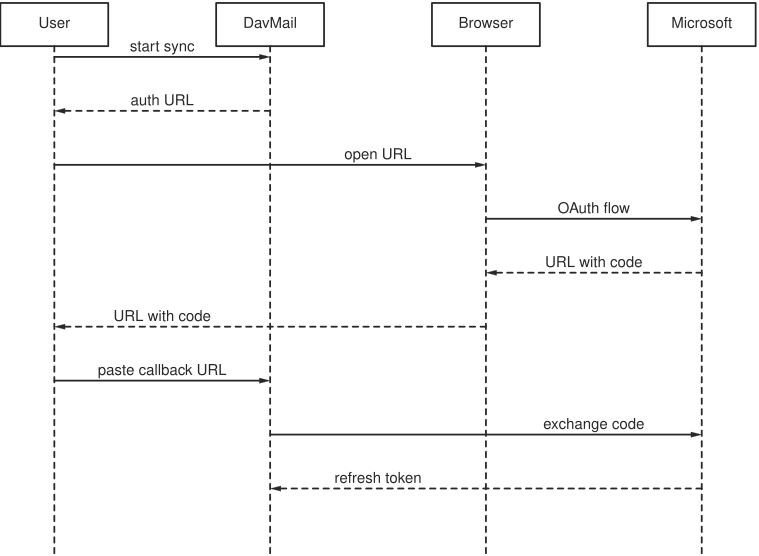
The flow is a bit unusual because davmail(1) can't open a browser
window itself; instead, it prints an authorization URL
to its terminal and waits for you to complete the
login in a browser and paste the resulting URL back.
In effect, you act as the courier between
davmail(1) and the browser:
Once you've configured your email client to use davmail(1), attempt to connect to
the email server. This can usually be done by manually
requesting an email synchronization. Using the configurations
above, the command for this is,
mbsync university
The email synchronization will block, and you
should see an authentication prompt in your davmail(1) terminal,
Please open the following link:
https://login.microsoftonline.com/common/oauth2/authorize?<...>
proceed through authentication steps and paste back the final url
that contains authentication code (blank page)
Authentication code:
Copy and paste the provided URL into your web browser, and you will be presented with an Office365 login screen, or possibly with a blank white screen if you are already authenticated with Office365 in your browser. If you don't get a white screen right away, complete your sign on as usual, after which you should get the white screen.
Once you're on the white screen, copy and
paste the entire URL from your browser into the
davmail(1) terminal
window, and hit enter. This will complete the
authentication process. Don't worry if davmail(1) writes more text to the
terminal between when you copy the URL and paste the
new one in--this won't hurt anything. Ignore the new
text and paste the URL anyway.
There are fairly good odds your email sync will have timed out by now. If it did, attempt to sync your email a second time. It should now work without any manual intervention.
If you examine your davmail(1) configuration
file again, you should see a new entry called
davmail.oauth.<email>.refreshToken.
This is the token that you retrieved during the manual
sign-on process above.
This token is part of the authentication process, and should be treated with the same care as a password. Be careful not to commit it to a git repository. If you do leak the token, you can invalidate it by changing your Microsoft account password.
The token will remain valid for some time (I don't know
precisely how long, but it is on the order of weeks in
my experience), during which you can automatically
authenticate with Outlook even if your davmail(1) is running as a service
in the background. If at some point your authentication
fails randomly, it is likely that the token has expired,
in which case you only need to repeat the above process
to get a new token.
Conclusion#
And that is all there is to it. With a small amount of manual
intervention every couple of weeks, you should be able to use
a desktop email client with your Microsoft email account on
Linux and BSD. I've been using this system for several years
now, and it's been working quite reliably. The only downside
is that davmail(1) is fairly slow
compared to a native IMAP interface for email synchronization.
But, this is a minor inconvenience, and I much prefer dealing
with slower email syncs than using the Outlook web interface.